5 years ago

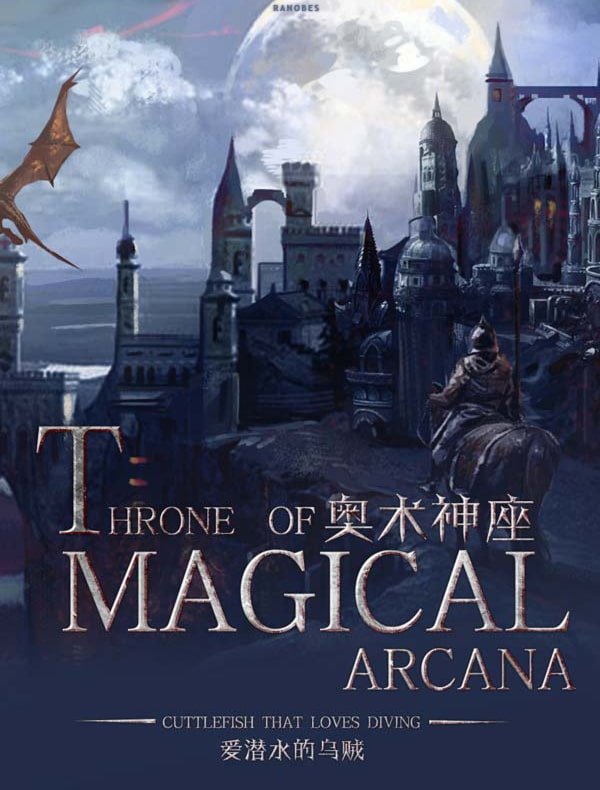
Throne of Magical ArcanaArcane Divine Throne

奥术神座

An ordinary young man on earth, Xia Feng, traveled to a world of sword and magic, and took the body... Read more
An ordinary young man on earth, Xia Feng, traveled to a world of sword and magic, and took the body of Lucien Evans, another ordinary young man. Seemingly this was a world of traditional western fantasy, yet he discovered the astonishing similarities between the earth and this world, and between science and the so-called arcane magic…

«Knowledge is power»? Soul, magic, quantum, Theory of Relativity, cognitive world, music and real world……

What was the true nature of that world? Collapse
  • Views: 107 595
  • Total views: 3 280 701
  • Comments: 86
  • Total comments: 5 656
Information
Users of Guests are not allowed to comment this publication.

Comments 86

  1. Offline
    + 00 -
    As one of the earlier novels from Cuttlefish, it suffers from being written by the same author as LOTM.

    I’m personally a sucker for fantasy research, so the only bad thing I can say about MC’s researching and development is that it’s not really explored. He’ll start a research project and then it’ll be done the next chapter, which makes the process feel rushed and unearned.

    Unfortunately, the translation quality leaves much to be desired, with sorcerers and nobles speaking in slangs during extremely formal events, absolutely breaking immersion and removing any attachment to any plot being discussed.

    Despite its shortcomings, it’s a good novel for it’s time, poor translation be damned.
    Read more
  2. Offline
    + 10 -
    I remember learning about the Christian clergy's role in the investigation and development of the natural sciences.

    In particular I remember learning that the "Dark ages" were ended by monks.

    The below is from brave AI:

    Medieval monks were central to preserving and advancing science during the so-called Dark Ages, contradicting the myth that this period was intellectually stagnant. Monasteries served as vital centers for scholarship where monks copied classical manuscripts, developed new technologies, and conducted scientific inquiry in fields like astronomy, mathematics, and engineering.

    Key contributions include:

    Preservation of Knowledge
    : Monks maintained libraries and transcribed texts, ensuring that ancient Greek and Roman scientific works survived the fall of the Western Roman Empire.

    Technological Innovation: Monastic communities invented or refined tools such as mechanical clocks, eyeglasses, the heavy plow, and water mills, which significantly advanced agriculture and daily life.
    Scientific Inquiry: Scholars like the 14th-century monk John Westwyk engaged in sophisticated astronomical calculations and instrument making, while Irish monks led Europe in Computus (the calculation of Easter dates) and mathematical computation between AD 500–1000.

    Educational Foundations: Monastic schools eventually evolved into universities, formalizing higher education and laying the groundwork for the Scientific Revolution in the Early Modern Period.

    While the Early Middle Ages saw a decline in scientific progress following the collapse of Rome, the High and Late Middle Ages witnessed a resurgence of intellectual activity. By the 14th and 15th centuries, monks and clerics were actively contributing to natural philosophy, medicine, and mechanics, directly enabling the later advancements of the Renaissance and Scientific Revolution.

    The below is from "The clergy behind science as we know it."

    Published by The Christian History Institute.

    Pastors promoting science
    But in fact a Lutheran minister and theologian named Andreas Osiander (1498–1552) was the one who published Copernicus’s seminal piece. That should be our first clue that the story of enmity between Christianity and science has often been distorted and overstated, leading us to forget some of history’s most influential science advocates and fueling a false dichotomy.

    The prevailing narrative that Christianity is inherently antiscience gained acceptance in 1896 with Andrew Dickson White’s A History of the Warfare of Science with Theology and Christendom (see p. 33). White singled out prominent Protestant pastors such as John Wesley and Increase Mather for promoting an attack on the new science. “From the first to last,” White wrote, “a long line of eminent divines, Anglican and Calvinistic, strove to resist new thought.”

    Wesley had already been singled out by other nineteenth-century writers for opposing scientific reasoning in support of the orthodox Christian faith. Yet Wesley’s own publications engaged the science of the times by advocating for the usefulness of electricity, exploring natural philosophy, and promoting natural solutions for curing diseases (rather than merely spiritual solutions). White conveniently ignored these writings in his hypothesis.

    White is correct in at least one regard: if a war had been waged between theology and science, some prominent Enlightenment-era pastors would have led the charge. Yet when we delve into the history of eighteenth-century clergy, we discover a different story: pastors who engaged the latest scientific discoveries and experiments in a variety of ways and with a predominantly receptive attitude. The very idea that science and Christianity inherently conflicted would have defied their theological mindset.

    Pastors after the Scientific Revolution viewed engagement with new science as an opportunity to understand God as Creator with greater depth to bring him greater glory. Clergy were frequent promoters rather than detractors, enthusiasts and participants rather than fear mongers. Their observations and contributions through publishing, preaching, and their own scientific pursuits helped enable the advancement of modern science in western communities.

    P. S.

    I harbour faith nor trust in neither a "Creator God" nor Scientism, but see them as two views delighting and seeking safety in that which is created, subject to causes and conditionditions; that is to say impermanent and perisable.

    "the science" or a Creator God both revolve around creationism.

    What is created will cease. Trusting in, believing or putting faith in such is futile and foolish.
    Read more
  3. Offline
    + 22 -
    bro female lead is fkn lesbian🤮
    Read more
    1. Online Offline
      + 00 -
      people hate on u, but u right
      Read more
  4. Offline
    + 00 -
    Error in pricing calculated below (besides the usual error of everyday goods increasing my orders of magnitude when MC increases in wealth)

    Quote: Chapter 191:
    “Paean of Night,” Lazar pointed at his own coat, “Level two medium rank, two hundred Thales or arcana points, from Wasim’s, good price, good quality, good reputation.”


    Coat/Robe prices:

    Level 2 medium rank: 200~ (random merchant)

    Level 3 Medium rank: 2000~ (the headquarter of the Will of Elements, Holm Royal Magic Tower)

    Level nine high rank: 1,000,000 (the headquarter of the Will of Elements, Holm Royal Magic Tower)

    Asking duck ai:
    Considering a rank 3 item costs 2000 and a rank 9 costs 1,000,000, the cost multiplier being 500 increasing 6 ranks, assuming the multiplier to be constant across ranks, what is that multiplier?

    We want m such that 2000 * m^(9-3) = 1,000,000 with exponent 6.

    m^6 = 1,000,000 / 2000 = 500
    m = 500^(1/6)

    Compute: 500^(1/6) ≈ e^{(ln500)/6} ≈ e^{6.214608/6}=e^{1.035768}=2.817

    So the multiplier ≈ 2.817 (more precisely 500^(1/6)).

    What should a rank 2 item cost, in that case?

    Multiplier m = 500^(1/6) ≈ 2.817.

    Rank numbers: cost at rank r is C_r = C_3 * m^(r-3). For rank 2:
    C_2 = 2000 * m^(2-3) = 2000 / m ≈ 2000 / 2.817 ≈ 709.7

    So about 710 (units).

    710/ 200 = 3.55

    Cuttlefish's pricing is off by a factor of 3.55 estimated conservatively, considering higher ranked (read: rarer) resources are expected to increase exponentially in cost and the fact that the prices at the joint headquarter of the Will of Elements and Holm Royal Magic Tower for internal staff should be at a discount compared to a merchant.
    Read more
  5. Offline
    + 00 -
    • 4.3
    4.3
    After struggling for a while not to drop it, I finally finished the novel.. overall it has a solid storyline and good progression. The MC cleverly uses physics and chemistry principles to enhance magic, but the writing often feels like reading a scientific or research log!!
    Read more
  6. Offline
    + 21 -
    I read this before LOTM and would always prefer this to LOTM. I got hooked with this and i wish cuttlefish actually gave this novel attention. Not even a single illustration Smh
    Read more
  7. Offline
    + 10 -
    Am currently at chapter 195 and idk why but suddenly it feels like MC is being sloppy af.

    Volume 1 he was EXTREMELY cautious and tried to be as smart and careful as he could.

    Volume 2 he started acting fairly sloppy. He walked into a necromancer castle/trap, despite feeling uneasy about it before and during the meeting. He took part in some random mage meeting just because he got info about it and 2 invites from looting others. And with that he even used his old pseudonym from Volume 1 that he originally planned to drop because it was way too dangerous. He basically managed to BS his way through the encounter...barely.

    The good thing with Volume 2 is that, after the stuff above, he realised that he wasnt acting carefully and said it was due to being overconfident after his becoming a Wizard and his successes (end of Volume 1) and that he would try and be more careful.

    Yet in Volume 3, now he is finally in the mage continent/area, he is basically back to being sloppy af.

    He made a joke about leaving an X in blood and the person he was talking to mentioned straight away that was just like Professor (his pseudonym he was supposedly trying to hide/drop.)

    He took a teaching job (for magic) but then when he learns they offer music classes he decides to also teach Piano and Violin, even though basically EVERYONE automatically links Piano to Lucien Evans and ALWAYS comments on their names being the same. Its like he's is just f#cking begging for people to figure out they are the same person.

    Speaking of names, the novel suddenly makes it seem like Lucien Evans is such a common name its no surprise to run into people with that name f#cking everywhere. He has to use a letter after his name in his papers to differentiate himself (he chooses X) and one of the other teachers at the school also has the same name too. Just feels really forced to try and explain away why people don't automatically assume he is the same as the famous musician guy (even though they ARE the same). But him deciding to make it clear he is also knowledgeable and interesting in music doesnt f#cking help at all.

    I'm kinda hoping it improves later on, since the whole magic system and its link to science does sound pretty interesting. I just don't want to continue on if he keeps acting this sloppy going forward...might pause it for now I guess.
    Read more
  8. Offline
    + 00 -
    I think that after some time, I will read it again.
    Read more
  9. Offline
    + 00 -
    I'm liking the musical element, and j just read Singer, Sailor, Merchant, Mage. Any other musically inclined stories? happy-birthday2
    Read more
  10. Online Offline
    + 10 -
    Мне понравилось.
    Но конец истории завершен за 2 главы... Ответы на вопросы и битва с боссом.
    Для меня это слишком мало и слишком быстро.
    Необычный стиль автора. Добавлено много научных терминов и понятий.
    Сделано качественно.
    С переводом нет проблем. Это значит, что редактор хорошо поработал.
    4,5/5 заслуженно.
    Это произведение стабильное, но понравится не всем. Некоторые посчитают его скучным.
    Также здесь 800 глав основной истории.
    Read more